
SpongeBob Adventures: In A Jam
Tilting PointSimulation
4.64.50K Reviews
- Version
- 2.35.1
- Installs
- 10.00M
- Age Rating
- Everyone
Screenshots
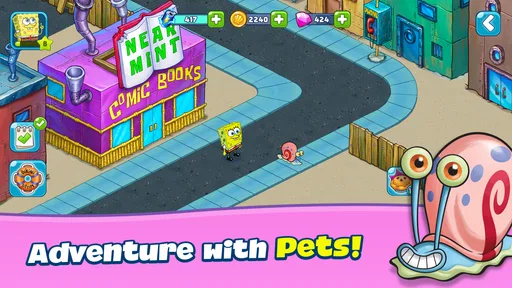
Our Review of SpongeBob Adventures: In A Jam
 Analysis by Appyee
I spent time with SpongeBob Adventures: In A Jam expecting a light cartoon game, but its strongest quality is the way it turns a familiar Bikini Bottom cast into a steady routine of small objectives. You are not simply watching SpongeBob characters move through a story; you are building, exploring, and working through tasks that gradually make the world feel more complete. That makes it a comfortable choice for short visits, although the same slow-burn structure will not suit anyone looking for constant action.
This is a free simulation game from Tilting Point, rated for Everyone. It has attracted over ten million installs and holds a 4.6 average from around 130 thousand ratings, which gives a useful indication of its broad appeal. I can understand that reach: the presentation is approachable, the recognizable characters do much of the emotional work, and the basic loop is easy to understand without a long explanation.
How the first goals pull you into Bikini Bottom
The opening experience works best when you treat it as a sequence of manageable jobs rather than a race toward a final destination. Early goals give you a reason to inspect the surroundings, collect what is needed, and make visible improvements. I found that more satisfying than being dropped into a large map with no clear sense of priority. Each completed task helps answer the immediate question, “What should I do next?”
That clarity is especially useful for younger players and for anyone who prefers relaxed games. The Everyone rating matches the gentle tone, and the SpongeBob setting keeps the early work from feeling like a spreadsheet. Familiar faces and playful presentation soften the more repetitive parts of gathering and building. I never needed to understand a complicated simulation before making progress.
One practical way to play is to begin each session by checking every active objective instead of immediately spending resources on the first available improvement. Some tasks naturally overlap. If one goal asks you to gather something while another benefits from the same trip around the area, completing them together makes the session feel more efficient. This is a small habit, but it matters because the game’s pace is designed around several modest actions rather than one dramatic breakthrough.
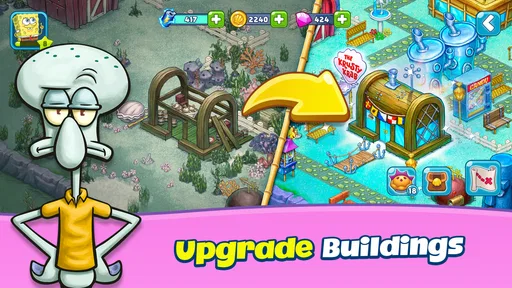
The adventure also benefits from giving progress a visual purpose. A new construction or repaired area is easier to appreciate than an abstract number rising in a menu. I paid more attention when an objective changed the look or usefulness of the surrounding world. That connection between task and result is one of the reasons the game feels more inviting than a purely menu-driven management title.
Still, the beginning is not a demanding test of planning. Players who want deep strategy from the first minute may find the initial goals too gentle. The game teaches its rhythm gradually, and that is a strength for accessibility but a limitation for experienced simulation fans who want immediate complexity.
Progress feels clearest when the world changes
The most convincing progress signals are the ones I could see rather than merely claim. Completing an objective, opening another part of the adventure, or improving the environment gives a session a clear ending point. These moments are important because the individual actions can be simple. Without a visible result, collecting and waiting would feel like chores; with one, they become steps in a larger makeover.
I also liked the way character familiarity supports progression. SpongeBob and the surrounding world give context to otherwise ordinary errands. A task has more personality when it belongs to this setting instead of being presented as a generic request from an anonymous manager. That does not turn every objective into a memorable story beat, but it keeps the routine connected to the world.
A useful approach is to pause after a meaningful unlock and look at what has actually changed before starting another chain of tasks. Doing so helps you decide whether the new area deserves immediate attention or whether finishing an older objective will create a smoother path. I found this particularly helpful during shorter play sessions, when I wanted one complete result rather than several half-finished activities.
The game’s progress signals are also friendly to players who do not play every day. Because the experience is divided into clear goals, returning after a break does not require remembering a complicated strategy. You can usually identify the current direction and resume. That makes it more suitable for casual play than simulation games that punish a missed day with a large backlog of systems to manage.
There is a trade-off here. Players who enjoy discovering hidden interactions or optimizing a large network may eventually find the visible goals too straightforward. The appeal lies in steady completion and world-building, not in uncovering a highly intricate simulation model. I would recommend it to someone who wants to feel progress without needing a notebook, but not to a player searching for a demanding economic puzzle.
The difficulty curve stays welcoming, with friction arriving through pace
My impression of the difficulty curve is that it increases more through patience and planning than through reflexes. The early tasks establish the routine, while later progress asks you to think more carefully about the order of actions and the resources you are willing to commit. That is a reasonable way to add challenge in a simulation game because it keeps the controls accessible while making decisions gradually more important.
The challenge is therefore less about losing a battle and more about managing momentum. If you spend something too quickly, you may have to wait for another opportunity to continue. If you start several objectives at once, your attention can become scattered. I learned to choose one main target for a session and treat other activities as useful extras. That simple priority system reduced the feeling of being pulled in too many directions.
Another non-obvious strength is that the game rewards planning around time rather than demanding constant attention. I could make progress in a short visit, leave, and return later with a clearer next step. This makes it a good fit for a commute, a quiet break, or a few minutes before bed. It is not necessary to turn the game into an all-day commitment for the basic progression loop to make sense.
On the other hand, anyone who dislikes waiting or repeated collection may experience the curve as a slowdown rather than a satisfying increase in challenge. The distinction matters: a patient player may see a useful pause for planning, while an impatient player may see an obstacle between story moments. If your ideal simulation lets you make rapid decisions continuously, a more active alternative will probably feel better.
I also would not choose this as my main game when I want a high-pressure challenge. Its tone remains gentle, and the familiar humor is more important than punishment. That is appropriate for the audience, but it means the later experience should not be judged by the standards of a competitive strategy game. The game asks you to organize your progress, not prove superior reaction speed or tactical skill.
Unlocks keep the routine moving, but the free structure can press for patience
The progression has a comfortable sense of accumulation. You complete tasks, improve the setting, and work toward access to more of the adventure. Unlocks matter because they give the routine a destination. I was more willing to repeat a familiar activity when I knew it contributed to a new piece of the world rather than disappearing into an endless meter.
That said, the free-to-play structure is part of the experience and should be considered before installing. The game is free to download, but it includes optional in-app purchases ranging from $0.49 to $119.99 per item. The wide range means different players will encounter the purchase system differently, but I would still recommend deciding in advance whether you intend to spend anything. Going in without a limit can make a relaxed game feel more urgent than it needs to be.
My preferred method was to treat purchases as an optional convenience rather than part of the core objective. When progress slowed, I first looked for a better order of tasks and used the available session to finish something smaller. This helped preserve the satisfaction of earning an unlock. The game is more enjoyable for me when I accept its measured pace instead of trying to remove every pause.
This is also where the game differs from a traditional offline-style building toy. In a purely self-contained alternative, the focus may be on placing structures freely and experimenting with layouts. Here, the adventure framing and objective chains provide stronger direction, but they can also make progress feel more controlled. Choose this game if you like being guided through a themed journey; choose a sandbox-style option if unrestricted building matters more than character-led goals.
The retention pressure is mild at first because the setting itself is pleasant to revisit. I often returned simply to see which task had become available and whether a small improvement could be completed. Over time, however, repeated collection and slower objectives can test that goodwill. The game needs the player to enjoy the routine, not merely tolerate it while waiting for the next major unlock.
A helpful habit is to stop after completing a satisfying objective instead of continuing until every available action is exhausted. Ending on a clear success keeps the next session appealing and prevents the routine from turning into a grind. This is particularly useful for children, who may otherwise focus on chasing the next reward without noticing how long they have been playing.
Who will enjoy the progression and who should skip it
I think this is a strong match for SpongeBob fans, families looking for a friendly simulation, and casual players who enjoy building up a recognizable world in small steps. It also works for people who prefer goals with obvious direction. You do not need to be an expert in management games to understand the basic rhythm, and the Everyone rating makes the tone broadly approachable.
A realistic everyday scenario would be a short evening session after dinner. I might open the game, review the current objectives, complete the task that is closest to finished, and use the remaining time to prepare the next improvement. That creates a compact sense of accomplishment without requiring a long uninterrupted block. The same structure can work during a lunch break, provided you are comfortable leaving longer goals to continue at their own pace.
I would skip it if you want a fast arcade experience, a complex city simulator, or a game where every decision has immediate high stakes. I would also be cautious if you are easily frustrated by free-to-play pacing or if you prefer to avoid optional purchases entirely. The cartoon presentation may attract you, but the underlying loop still asks for repeated attention and patience.
Compared with the usual alternatives in simulation, this game places more emphasis on an established animated world and guided adventure than on unrestricted systems. That makes it easier to enter and more emotionally recognizable, but it may offer less satisfaction to players who want elaborate optimization. In comparison with action-focused SpongeBob games, it is calmer and more deliberate. The fun comes from making the setting grow, not from mastering rapid movement or combat.
Parents should also think about how they want the game used. The accessible objectives make it easy for a child to understand what to do, but the free-to-play format means purchase boundaries are worth discussing before play. I would encourage using the game as a short, goal-based activity rather than an open-ended source of endless screen time. Its structure supports that approach well because a session can naturally end after one completed improvement.
My verdict on the long-term progression
After looking at the way goals, unlocks, challenge, and pacing work together, I see SpongeBob Adventures: In A Jam as a welcoming simulation built around steady momentum. It succeeds when the player enjoys small improvements, recognizable characters, and a world that becomes more complete through repeated effort. The early objectives are clear, the progress is easy to read, and the difficulty grows mainly by asking for better timing and prioritization.
Its weaknesses are closely tied to those strengths. The gentle curve may feel too soft for experienced strategy players, while repeated tasks and slower pacing can become tiring for anyone who wants constant novelty. Optional purchases add another layer of restraint, especially when you are tempted to speed up progress. I found the best experience came from accepting the intended rhythm and setting a personal spending boundary before beginning.
The game is currently at version 2.35.1 and runs on Android 8.0 or later. It was released on September 26, 2023, and remains free to start. Those details make it easy to approach, but the real decision is whether its particular kind of progression matches your habits. Do you enjoy returning to a cheerful world, completing a few practical goals, and watching the results build over time? If yes, this is an easy recommendation.
If you need deep simulation mechanics, unrestricted construction, or rapid challenge, I would point you elsewhere. For everyone else, especially fans who want a relaxed SpongeBob-themed adventure rather than a demanding strategy test, SpongeBob Adventures: In A Jam offers a pleasant loop with enough structure to keep short sessions meaningful. My final advice is simple: play it as a patient, objective-driven game, and its pacing feels intentional rather than slow.
Verdict
Strengths of SpongeBob Adventures: In A Jam
- Charming SpongeBob-themed world with colorful cartoon visuals.
- Simple controls make it accessible for younger and casual players.
- Many familiar characters appear throughout the adventure.
- Town-building lets you customize and expand Bikini Bottom areas.
- Regular tasks provide clear goals and steady progression.
Limitations of SpongeBob Adventures: In A Jam
- Energy limits can interrupt longer play sessions.
- Some upgrades and items require considerable waiting time.
- Premium currency purchases may speed up progression noticeably.
- The gameplay can become repetitive after completing similar tasks.
- An internet connection may be needed for several features.
Other Releases by Tilting Point
View All
Star Trek™ Timelines
Role Playing3.7

Warhammer: Chaos & Conquest
Strategy4.4

Avatar: Realms Collide
Strategy4.5
Similar Picks in This Category
View All
Truckers of Europe 3
Wanda Software4.3

Town Building Life Simulator
XGame Global4.2

Fidget Toys Trading・Pop It 3D
Freeplay Inc4.7

Sculpt People
CrazyLabs LTD4.4

Scary Teacher 3D
Z & K Games4.2

Hair Tattoo: Barber Shop Game
CASUAL AZUR GAMES4.3
Frequently Asked Questions
What is SpongeBob Adventures: In A Jam?
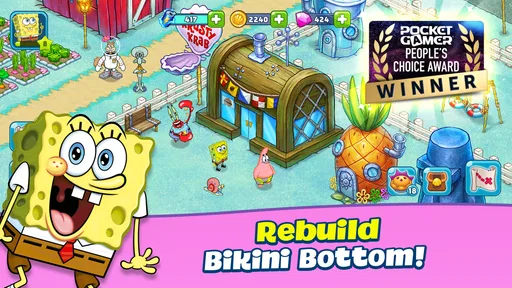
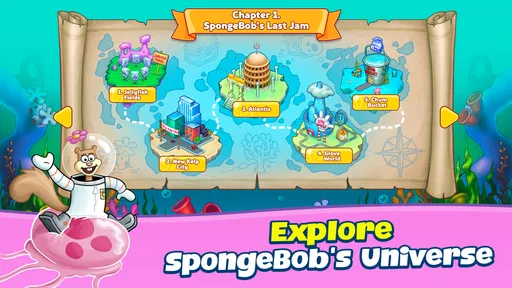
SpongeBob Adventures: In A Jam is a casual adventure and resource-management game set in the SpongeBob SquarePants universe. Players help SpongeBob restore Bikini Bottom after a jelly-related disaster, explore familiar locations, gather materials, complete quests, grow crops, craft useful items, and unlock characters. The game combines light exploration with city-building and collection mechanics, making it suitable for players who enjoy relaxed, story-driven mobile games.
How do you play SpongeBob Adventures: In A Jam?
The main gameplay loop involves completing missions, collecting resources, clearing obstacles, producing items, and rebuilding different areas of Bikini Bottom. Energy is generally used to perform actions, so progress requires some planning rather than tapping randomly. As new areas become available, players can discover additional tasks, decorations, characters, and production buildings. The controls are simple and designed for touchscreen play, so the game is easy to understand even for casual players.
Is SpongeBob Adventures: In A Jam free to download and play?
SpongeBob Adventures: In A Jam can generally be downloaded and played for free, but it includes optional in-app purchases. These purchases may provide premium currency, extra resources, energy, bundles, or faster progress. You can experience the story and complete many activities without paying, although waiting periods and limited energy can make progress slower. Families should review device purchase settings, especially if children may access the game.
Does SpongeBob Adventures: In A Jam require an internet connection?
An internet connection may be required for certain features, including loading the game, synchronizing progress, receiving updates, displaying events, and processing purchases. While some parts of gameplay may work briefly without a stable connection, the experience is more reliable when connected to Wi-Fi or mobile data. Players should also keep the app updated, since online events, account features, and newly added content may depend on the latest version.
Is SpongeBob Adventures: In A Jam suitable for children?
The game is colorful, cartoon-focused, and based on a well-known family entertainment franchise, so it can appeal to children and younger players. Its basic controls and gentle adventure theme are easy to follow. However, it may contain advertisements, optional purchases, timers, and mechanics that encourage continued play. Parents should check the age rating for their region, enable purchase restrictions, and review privacy or account permissions before allowing children to play independently.
Play our best games!


